Description
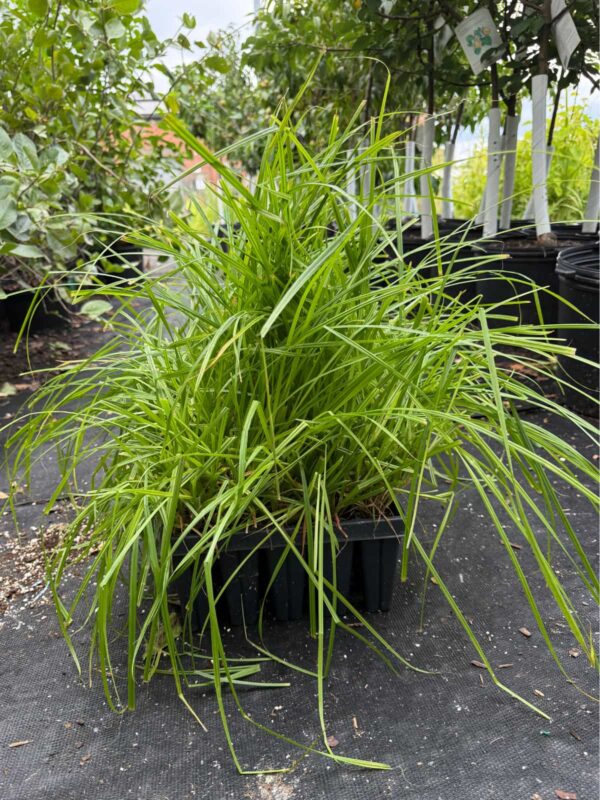
Common Fox Sedge (Carex stipata), also known as Awl-fruited Sedge, Awlfruit Sedge, or Prickly Sedge is a vigorous native wetland sedge prized for its dense clumps of arching foliage and distinctive spiky seed heads. Growing 3 to 4 feet tall, it establishes quickly and is one of the best sedges for restoring wetlands and stabilizing moist soils.
As a cool-season sedge, Common Fox Sedge grows most actively during the spring and fall. It thrives in full sun to full shade and prefers consistently moist to wet soils. Naturally found along riverbanks, floodplains, marshes, wet meadows, woodland edges, and shorelines, it is highly adaptable and performs exceptionally well in rain gardens, bioswales, and other stormwater management projects.
This species spreads gradually by rhizomes, forming colonies that help reduce erosion, improve water quality, and outcompete weeds in wet areas. Its rapid establishment and tolerance of changing water levels make it a valuable choice for ecological restoration and naturalized landscapes.
Common Fox Sedge also provides important wildlife benefits. Its dense foliage offers cover for insects and small animals, while numerous caterpillar species feed on the leaves. The seeds are eaten by woodcocks, ducks, swamp sparrows, and other wetland birds. Deer and other mammalian herbivores generally leave it alone.
If you’re looking for other native sedges for wet landscapes, Bristly Sedge (Carex comosa) features distinctive bottlebrush seed heads, Emory’s Sedge (Carex emoryi) is excellent for streambanks and floodplains, Water Sedge (Carex aquatilis) thrives in standing water, and Tussock Sedge (Carex stricta) forms attractive hummocks in saturated soils.
Shipping
Please note that we are an online seed supplier and nursery and have no retail store, but you may pick up your order at our warehouse if prior arrangements are made. Missouri sales tax applies to pickup orders.
Shipping Restrictions: We do not ship seeds, seed mixes, live plants, or other products to Alaska, Arizona, California, Hawaii, Maine, Nevada, Oregon, or Washington.
Seeds & Seed Mixes
Seeds and seed mixes ship year-round to eligible U.S. destinations, typically within 3–5 business days.
Seed Packets: Orders containing only seed packets ship for a flat rate of $7.30.
Seed Mixes:
- Midwest states (MO and surrounding states): $9.50 for the first seed mix, plus $1.50 for each additional seed mix.
- Outside the Midwest: $11.50 for the first seed mix, plus $1.50 for each additional seed mix.
If your order contains at least one seed mix, the seed mix shipping rate applies.
Free Shipping: Combined seed packet and seed mix orders totaling $100 or more qualify for free shipping.
Live Plants
Live plant shipping rates are calculated using UPS Ground rates based on your order and shipping destination. All live plant orders ship via UPS.
For larger quantities or species not listed online, we offer contract growing. Contact us to discuss your needs and request a quote.
Live Stakes
Live stakes are available by request only and must be ordered through our contact form.
Orders are accepted seasonally from November 1 through February 28. A minimum of 1,000 stakes per order is required, with at least 500 stakes per species.
Live stakes ship only to the following states: Missouri, Minnesota, South Dakota, North Dakota, Nebraska, Kansas, Oklahoma, Arkansas, Tennessee, Kentucky, Illinois, Indiana, Ohio, Michigan, and Iowa.
Shipping Seasons & Availability
Seeds & Seed Mixes
Seeds and seed mixes ship year-round, typically within 3–5 business days. If you would like to postpone a seed mix shipment until fall, please leave a note at checkout.
Live Plants
Live plants ship during spring and fall, depending on the species and growing conditions. Shipping dates may vary by species. Preorder announcements will be posted on our homepage. Check individual product pages for specific availability and shipping information.
Each species is listed with one of the following statuses:
- Pre-Order: Available to order for a future shipping window.
- In Stock — Shipping Now: Available and ready to ship.
- Out of Stock: Currently unavailable to order.
Availability and shipping status vary by species, so check each product listing before placing your order.
Plant orders ship on Mondays during the designated shipping season.
Live Stakes
Available for seasonal ordering from November 1 through February 28. See the Live Stakes section above for minimum order quantities and eligible shipping destinations.
Local Pickup
Local pickup is available by prior arrangement. Please contact us to coordinate pickup. Missouri sales tax applies to pickup orders.
Tax-Exempt Orders
Customers with a valid tax-exempt certificate or letter must contact us before placing an order to request tax-exempt processing. Please call us and email your tax-exempt documentation, or attach your certificate or letter to our contact form.
Once we receive your documentation, we can assist you with placing your order by phone or email. Orders must be placed directly with our team to ensure the appropriate tax exemption is applied.
Packing
Seed packets
Individual species are packaged and labeled in paper seed packets. Small orders ship in bubble mailers, while larger orders ship in cardboard boxes.
Seed Mixes
Online seed mixes are packaged in brown kraft paper envelopes or woven nylon bags and labeled with the species composition and Pure Live Seed (PLS) information. Rice hulls (inert carrier) will be included with seed mix orders. All orders will arrive in a cardboard box.
Plant trays
Plants are watered and packaged by flat in ventilated, travel-safe boxes. Plant orders ship on Mondays during the designated shipping season.
Live stakes
Live stakes are bundled and wrapped to help retain moisture, then shipped in insulated boxes.
Delivery
Orders are shipped via UPS. Once your order ships, you’ll receive an email with tracking information.