Description
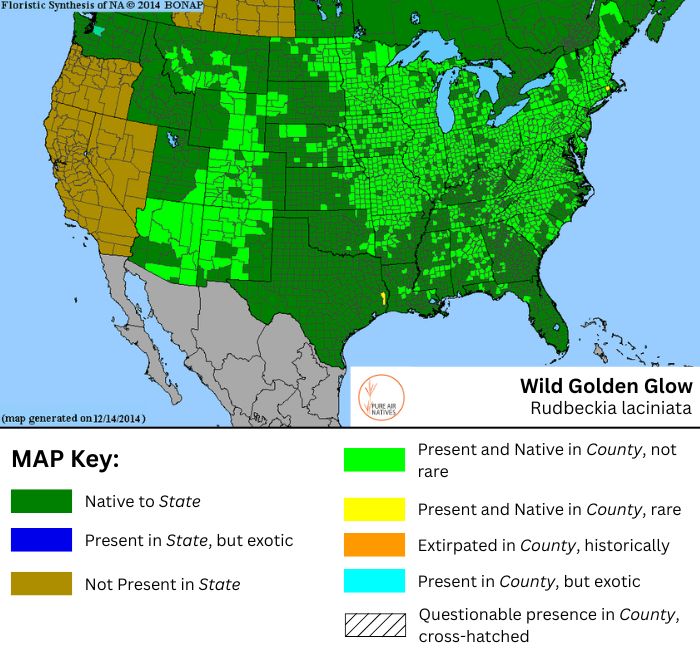
Wild Golden Glow (Rudbeckia laciniata), also known as Cutleaf Coneflower or Green-headed Coneflower, is a tall native wildflower named for its bright yellow blooms that seem to “glow” in the landscape, especially when planted in groups. The drooping yellow petals surround a greenish central cone, attracting bees, butterflies, and other pollinators while adding height to the landscape. It is one of the taller native wildflowers that can perform well in partial shade.
Wild Golden Glow grows best in part shade to full sun and moist soils. It can tolerate full sun when consistent moisture is available and is commonly found in moist woodlands, woodland edges, wet meadows, and along streams. Its tall stems and late-summer flowers make it useful for adding color and structure where shorter wildflowers may struggle.
This species spreads through rhizomes and can form large colonies, especially in moist conditions. It’s a popular option for rain gardens, wet meadows, and larger plantings, but its vigorous growth can make it difficult to contain in small garden beds.
Wild Golden Glow differs from other Rudbeckia species in its combination of height, shade tolerance, and preference for moist soils. Black-Eyed Susan (Rudbeckia hirta) is shorter and better suited to drier conditions, while Orange Coneflower (Rudbeckia fulgida) has a more compact, clump-forming habit. Brown-Eyed Susan (Rudbeckia triloba) is shorter and shorter-lived, while Sweet Black-Eyed Susan (Rudbeckia subtomentosa) can reach a similar height but is more clump-forming and less aggressive.
Wild Golden Glow is also known as “Sochan,” and its young spring leaves were traditionally used as food by the Cherokee.