Free Shipping on Online Seeds & Seed Mix Orders Over $100!

Generic selectors
Exact matches only
Search in title
Search in content
Post Type Selectors
Search in posts
Search in pages
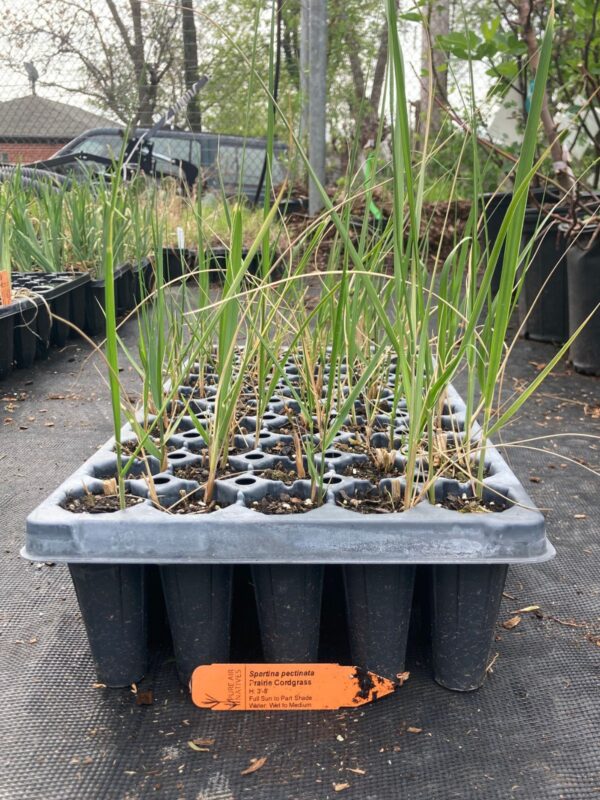
Prairie Cordgrass seedlings in 50 plug tray outside greenhouse
Spartina pectinata

Prairie Cordgrass

Plants

50 Plug Tray Out of Stock

Description

Prairie Cordgrass (Spartina pectinata) is a tall, robust native grass commonly found in wet prairies, marsh edges, and low-lying areas. It forms bold clumps of upright stems and wide leaves, typically reaching 4–7 feet tall and creating strong structure in the landscape.

In late summer, it produces distinctive, comb-like seed spikes that extend from the stem, adding texture and movement. As a warm-season grass, it grows most actively in summer and handles heat and wet conditions well.

Prairie Cordgrass thrives in full sun and prefers moist to wet soils, including fertile loam, but can adapt to a range of soil types if moisture is consistent. Once established, it can tolerate short dry periods. It spreads aggressively by rhizomes, forming dense stands that are excellent for erosion control, shoreline stabilization, and wetland restoration. Because of this, it’s best suited for larger areas rather than small garden spaces.

It is especially useful for competing with invasive species like Reed Canary Grass in wet sites. Its dense root system improves soil structure and provides valuable habitat. It supports specialist moth larvae, and its seeds and roots are eaten by waterfowl and muskrats. The thick stands also provide nesting cover for wetland wildlife.

Prairie Cordgrass pairs well with other moisture-loving natives like Blue Vervain (Verbena hastata), Swamp Milkweed (Asclepias incarnata), and Soft Rush (Juncus effusus). It also works well with structural companions like Common Arrowhead (Sagittaria latifolia) and Northern Blue Flag Iris (Iris versicolor), creating a layered, functional planting in wetland and shoreline settings.
Seed Details

Weight N/A
Dimensions N/A

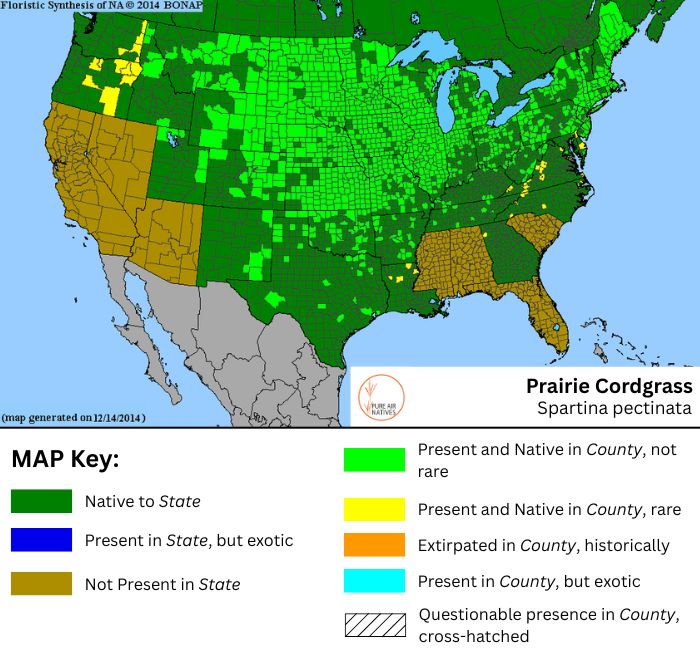
Range Map

Spartina pectinata native range map

Details

SociabilityColonies, Rhizomes
Sun RequirementsFull Sun
Soil MoistureMesic, Wet-Mesic, Wet
BenefitsErosion Control
Height6-7'
Hardiness Zone3 - 8
Bloom ColorTan
Bloom PeriodJuly, August, September
Spacing2-3'

Seeds & Seed Mixes:

Seeds and seed mixes ship nationwide, year-round, typically within 3–5 business days. If you would like to postpone a seed mix shipment until fall, please note this at checkout.

Live Plants:

Live plants are available year-round while inventory lasts and ship to all states except California, Arizona, Oregon, Washington, Nevada, Alaska, and Hawaii. After your order is placed, we’ll contact you to coordinate a spring shipping window, as many plants are overwintered and ship once dormancy breaks.

Estimated shipping for 2026 plant orders begins in mid-April, weather permitting.

If you’re looking to secure plants in advance or need larger quantities for a project, we offer contract growing options. Contact us to discuss your needs and request a quote. Additional species not listed online may also be available through contract grow.

Live Stakes:

Live stakes are available by request only and must be ordered by submitting a contact form. Ordering is open seasonally from November 1 through February 28. A minimum of 100 stakes per order is required, with at least 25 stakes per species.

Live stakes ship only to the following states: Missouri, Minnesota, South Dakota, North Dakota, Nebraska, Kansas, Oklahoma, Arkansas, Tennessee, Kentucky, Illinois, Indiana, Ohio, Michigan, and Iowa.

PLS stands for Pure Live Seed, an industry-standard measure of seed quality. It reflects the portion of seed in a batch that is viable and capable of germinating.

What this means for you: when you purchase 1 lb. of PLS seed, the physical weight of the seed you receive will be slightly more than 1 lb. That’s because we account for non-viable seed and natural inert material upfront, so you receive a full pound of live, plantable seed.

Many companies sell bulk seed by total weight, which can include filler and non-viable seed. By pricing based on PLS, we make sure you’re getting exactly what you paid for—high-quality native seed with more predictable, successful germination.

Want to dive deeper? Check out our in-depth article on what PLS is and why it matters.