Description
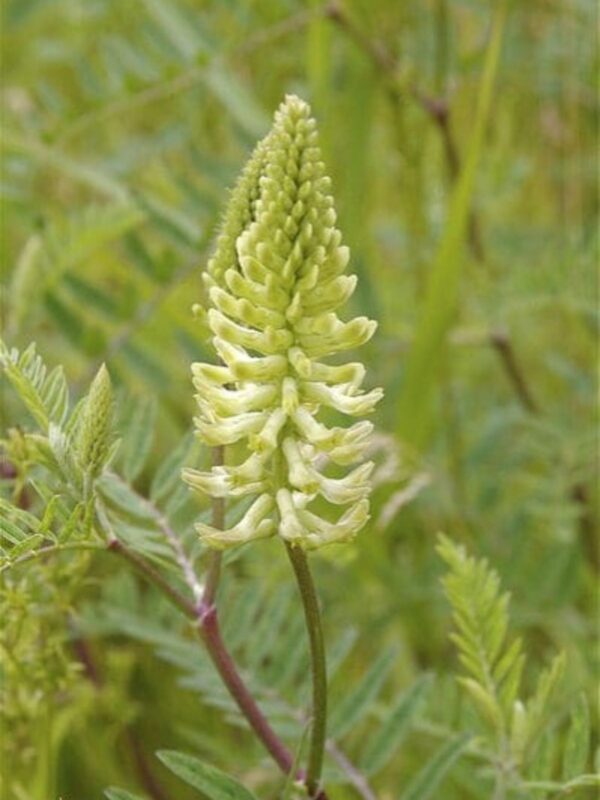
Canada Milkvetch (Astragalus canadensis), also called Canadian Milkvetch or Rattle Weed, is a versatile native wildflower that adds texture and attracts pollinators. It blooms from early summer into fall with clusters of small, creamy-white flowers touched with pale yellow.
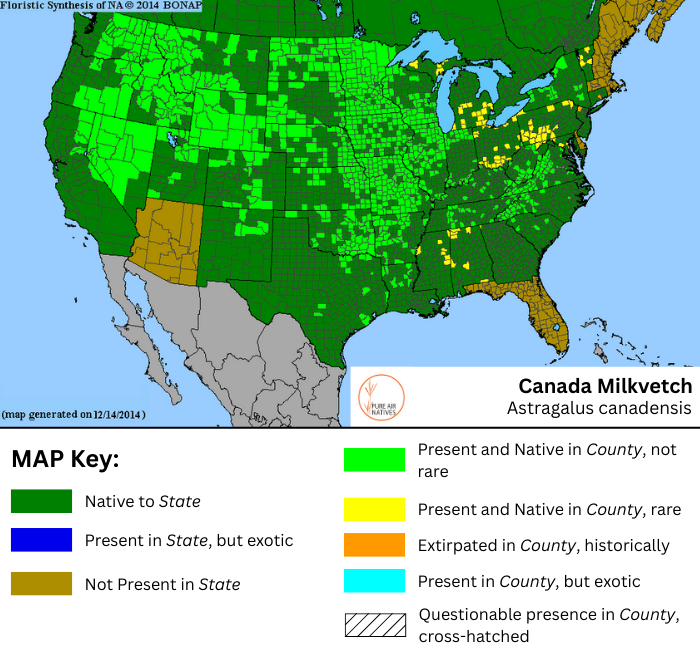
Growing up to about 3 feet tall, it has a soft, leafy appearance and works well in a variety of settings, including prairies, woodland edges, and streambanks. It thrives in full to partial sun and tolerates a range of moisture conditions, from medium-wet to medium-dry soils.
As a legume, Canada Milkvetch improves soil by fixing nitrogen. Its rhizomatous roots help stabilize soil and make it useful for erosion control. It is also an important wildlife plant. Bees, especially bumblebees and honeybees, visit the flowers regularly. It’s a host plant for the Clouded Sulphur and Western Tailed Blue butterflies. Hummingbirds are also attracted to the blooms.
Later in the season, the seeds provide food for birds such as wild turkey and other wildlife. The foliage is browsed by deer and small mammals, and it can serve as forage earlier in the growing season.
It is adaptable and easy to grow. However, like many Astragalus species, it should be used with caution in grazing areas because large quantities may be harmful to livestock.
Canada Milkvetch pairs well with other prairie natives like Switchgrass (Panicum virgatum), Big Bluestem (Andropogon gerardii), Purple Coneflower (Echinacea purpurea), and Black-eyed Susan (Rudbeckia hirta) for a balanced, wildlife-friendly planting.